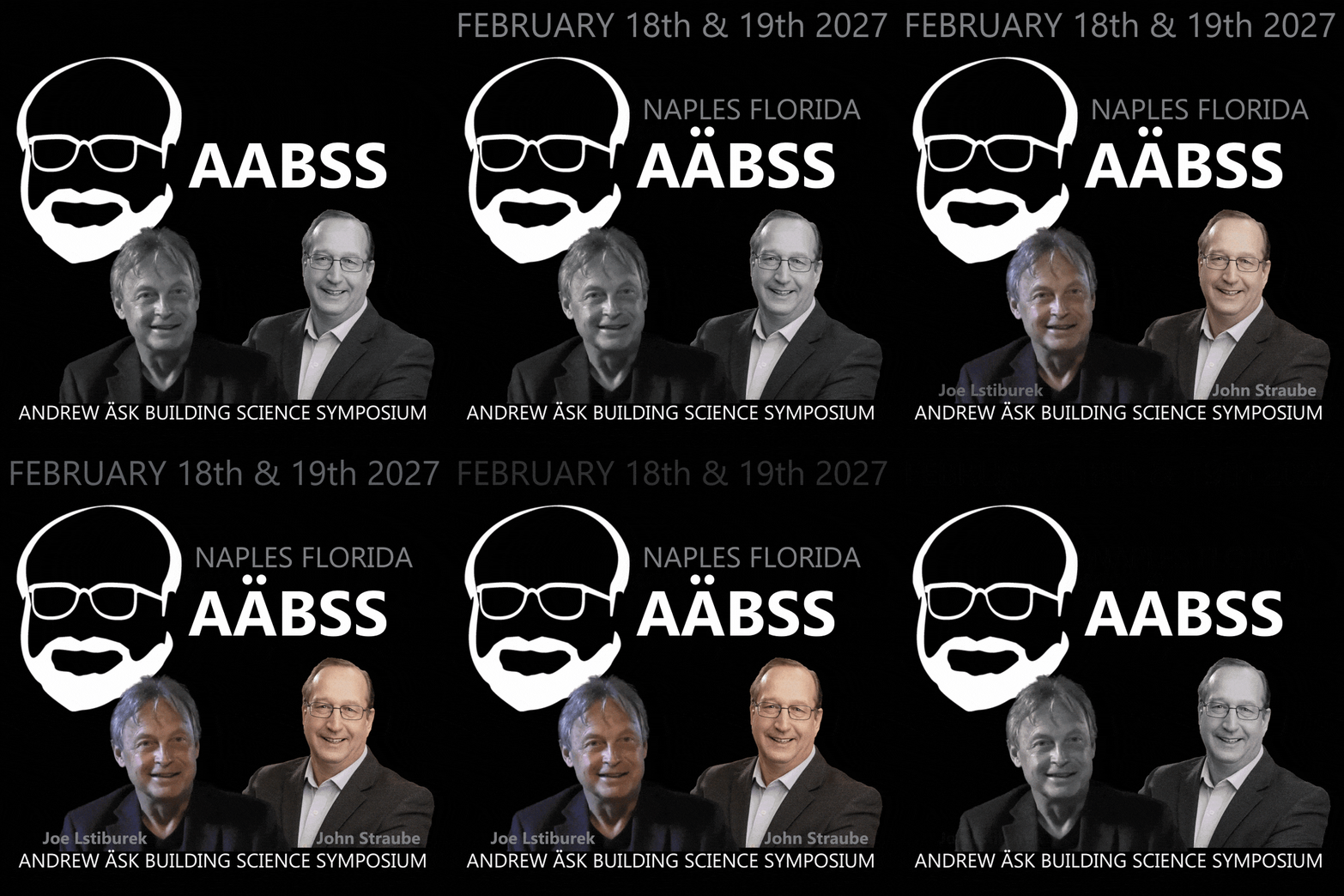
Andy's twenty seven year tradition of bringing world class building science education to Florida continues in 2027. The Andrew Ask Building Science Symposium features renowned speakers and engaging topics. AABSS-2027 brings leading construction industry knowledge presented by todays most relevant experts and influencers that you won’t see or hear anywhere else.

"That was our mission in 1998 when we started this and that’s what you can expect at AABSS-2027"

Joseph Lstiburek is the founding principal of Building Science Corporation. Dr. Lstiburek’s work ranges widely, from providing expert witness testimony to overseeing research and development projects, to writing for the ASHRAE Journal and buildingscience.com. Dr. Lstiburek’s commitment to advancing the building industry has had a lasting impact on building codes and practices throughout the world, particularly in the areas of air barriers, vapor barriers, and vented and unvented roof assemblies.
Dr. Lstiburek is also an acclaimed educator who has taught thousands of professionals over the past three decades and written countless papers as well as the best-selling Builder Guides. Fittingly, the Wall Street Journal has described him as "the dean of North American building science." He has a joy for telling tall tales to his protégés and audiences.
Dr. Lstiburek holds a Bachelor of Applied Science in Mechanical Engineering, a Master of Engineering in Civil Engineering, and a Doctor of Philosophy (Ph.D.)in Building Science. While still an undergrad, Dr. Lstiburek worked as a residential construction manager; during his Master’s degree, he developed the Air Drywall Approach to air barriers.
Dr. Lstiburek with his business partner Betsy Pettit, established one of the most influential, innovative, and respected building science authorities in North America.

John Straube is an Associate Professor joint-appointed to the Department of Civil and Environmental Engineering and the School of Architecture at the University of Waterloo. He researches and teaches building science, building materials, and engineering design with a focus on high-performance low-energy sustainable buildings. A registered professional engineer he is also a Principal at RDH Building Science Inc., where he leads forensic investigations, hygrothermal measurement and analysis research projects, and design projects in the areas of low energy building design, highly durable building enclosures, new building materials and systems, and extreme climate buildingsProfessor Straube authored “High Performance Enclosures” and co-authored “Building Science for Building Enclosures” with Eric Burnett. He received the Lifetime Achievement Award in Building Science Education from the National Consortium of Housing Research Centers (NCHRC).Professor Straube is a member of the CSA A371 Masonry Construction Standards Committee, the CAN/ULC S741-08 Standard for Air Barrier Materials, the American Society of Refrigeration and Air-Conditioning Engineers and the International Building Performance Simulation Association (IBPSA) Canada among others.
Older buildings leaked air, lots of it, and were rarely insulated. Heat moved freely through the walls: heat from outside dried wall cavities in summer, and heat from inside dried them in winter. Moisture rarely had a chance to settle in, and nobody talked much about “building science.” After the energy crises of the 1970s, we added insulation, and to let that insulation do its job, we tightened buildings up. That combination created a new problem: cooler cavities with a higher potential for condensation and less energy flowing through to dry them out. Building science exists to solve that problem, keeping tight, insulated buildings dry and free of rot and microbial growth. Air conditioning added a twist. In a generation it went from luxury to expectation, and here in Florida nearly every home and commercial building now has it. That’s wonderful for the people inside but harder on the building, because cooler interior surfaces sit closer to the dew point of humid outdoor air, and closer to trouble. The fix comes down to four control layers, applied in this order of priority: water, air,vapor and thermal. Everything at AABSS-2027 starts from those four control layers. And it’s not just for waterfront estates. The same physics that protects a custom home onthe water protects a duplex, a garden apartment or a 600 ft2 unit downtown. This year, several sessions show how these principles translate directly into affordable andbmultifamily housing, because good building science shouldn’t be a luxury amenity.
Ask enclosure engineers for the three biggest problems in buildings and you’ll hear the same answer: water, water and water. This session is John Straube’s practical answer to all three. Drawing on his widely cited work on rain control, John covers how buildings actually shed rain: deflect it away from the surface, drain what gets through, and let the rest dry out. Topics include sloped-roof drainage and what to do when slope alone won’t do the job: interior roof drains, insulated drain bodies, and the leader-and-downspout systems that carry water safely away from the building (yes, including a decorative discharge detail or two; enclosure engineers have always known how to make function look good). John also covers the often-overlooked role of gutters, along with drainage strategies for curtain walls and window openings.
Attics remain one of the most commonly mishandled assemblies in hot-humid construction. In this session, Joe compares vented and unvented (closed, conditioned)attics, vapor diffusion ports, and open- and closed-cell spray foam applied at the roof deck, including when code actually requires ventilation and when it doesn’t. He’ll dig into the everyday symptoms of getting it wrong: sweating ducts, condensation at bathroom supply registers, and the “ping-pong” humidity effect that can plague a sealed attic without the right control strategy. You’ll leave with a clear framework for deciding whether a sealed attic needs dedicated dehumidification and, if not, what to do instead.
Ian Cull of Indoor Science (Chicago) and Todd DeMonte of Overture Air Quality take on indoor air quality from the occupant’s point of view: comfort, health, mold and mildew risk, the role humidity plays in all of it, lab testing, air filtration and fine particulate matter(PM2.5).As enclosures get tighter, mechanical ventilation (ERV/HRV) stops being optional and becomes a core part of good design, a code-and-comfort issue this session takes on directly. Ian and Todd also look at IAQ in small urban apartments of roughly 600 to800 ft2, showing that the principles that protect a large custom home apply just as directly, and just as urgently, in affordable multifamily housing.
Two respected voices, one live and unscripted conversation. Joe Lstiburek and Kent Browning of KWR Engineering Services in Austin, Texas, join moderator Todd DeMonte for AABSS’s signature debate-style session, digging into where they agree, where they don’t, and what it means for the next project you design or build.
A 90-minute, clear-eyed look at where decarbonization and electrification actually stand today, technically and economically, for the people who design and build real buildings. This is a practical session, not a political one. John covers solar and wind power basics, the cost-effectiveness questions builders are asking, and where heat pump technology stands for water heating and space conditioning, including the challenges of retrofitting air-to-water heat pumps onto existing hydronic systems. He’ll weigh in on wood’s value for carbon storage, look at electric vehicles and utility rate structures, and preview next-generation refrigerants. He’ll also cover VRF systems: where they perform well, and where practitioners increasingly add supplemental dehumidification to get the results occupants expect. The session brings you current on the incentive landscape (what has expired, what remains at the state and utility level, and how to reset client cost conversations) and closes with a local issue many of us face: sea-level rise and stormwater drainage on low lying coastal sites.
Joe brings more than forty years as a building scientist to this keynote, and he built his reputation on telling audiences what the evidence shows rather than what’s comfortable to hear. This session traces residential ventilation science back to C.P. Yaglou’s landmark 1930sresearch at Harvard on odor and occupant comfort, then follows the thread forward to today’s ventilation codes and standards. Joe walks through what has changed, what much of the medical and regulatory community still gets wrong, and why “dilution” isn’t automatically “the solution.” His central message: design to code, then commission to comfort, because a code tells you how to build something, not how to make it work once it’s occupied. Expect a candid look at over-ventilation, a topic Joe has pushed back on hard in recent years, and a reminder that ventilation decisions carry real consequences for occupant health and safety.
Windows sit at the intersection of nearly every control layer discussed at this symposium: water, air, vapor and thermal all meet at the rough opening. This session covers window selection and durability in hot-humid, hurricane-exposed climates, thermal performance and condensation risk at frames and glass, and how to integrate window flashing with the wall’s drainage plane so the whole assembly works as one system.
The construction industry still doesn’t measure airflow the way it measures almost everything else in the field. Most systems are set up from fan tables, rules of thumb and assumed static pressures, and the actual airflow across the coil can be far from what the design called for. That gap shows up as poor dehumidification, shortened equipment life and capacity the owner paid for but isn’t getting. Accurate field tools now exist. In this 45-minute hands-on session, Gary Nelson of The Energy Conservatory demonstrates the True Flow Air Handler Flow Meter, DG-1000digital pressure and flow gauge, and Duct Blaster duct-testing system, explained in plain language for architects, engineers and builders. With equipment from The Energy Conservatory and additional support from Johnson’s Air Conditioning, the session gives you a hands-on feel for the tools that are changing what “verified performance” means.
Fair warning: this is a physics class, but you may not notice. In fifty entertaining minutes, John shows how physics and thermodynamics quietly govern every decision we make about heat and moisture in buildings, and why understanding a handful of relationships pays off on every project you touch. Expect a refresher on mass flow rate and why it matters more than the volume numbers(CFM, GPM) we’re used to talking about; a sampling of psychrometrics, including relative humidity, dew point and temperature, and when each one is the right tool for the job; and a look at why the relative humidity “inside” a material behaves differently from the relative humidity of the air around it.
AABSS closes where Jam Session I left off: live, unscripted and expert-driven. Gary Nelson and John Straube take on airflow in HVAC systems: when you need to measure it accurately, when knowing it approximately is good enough, and what it costs when you know neither.

THURSDAY 18th 5:30PM Immediately following Afternoon
Sessions for drinks and treats courtesy of Joyce Owens Architecture.
Meet Joe Lstiburek and John Straube.
Checkout Sponsor Exhibits.

NAPLES HILTON
5111 Tamiami Trail N.
Naples, Florida